Research explained · 2026
The Illusion of Insight in Reasoning Models
Do reasoning models really have “aha” moments—and do those moments help?
Findings of the Association for Computational Linguistics: ACL 2026 · Published in ACL Findings 2026
The finding
A mid-trace change of approach is not, by itself, evidence of useful self-correction. Across more than a million reasoning traces, spontaneous shifts were rare and seldom improved accuracy. In separate intervention experiments, triggering reconsideration when token entropy was high improved accuracy in the evaluated settings.
A change of approach is not the same as a breakthrough
A reasoning trace can look like a story of discovery: an initial approach, a phrase such as “wait, let me reconsider,” and a different answer. The important empirical question is whether the change actually makes the model more likely to solve the problem.
In The Illusion of Insight in Reasoning Models, we investigate that question across training checkpoints, tasks, decoding temperatures, and model families. We distinguish an observable reasoning shift from a stronger operational claim about an “aha” event.
A verbal cue or an ultimately correct answer does not establish that the intervening shift caused an improvement.
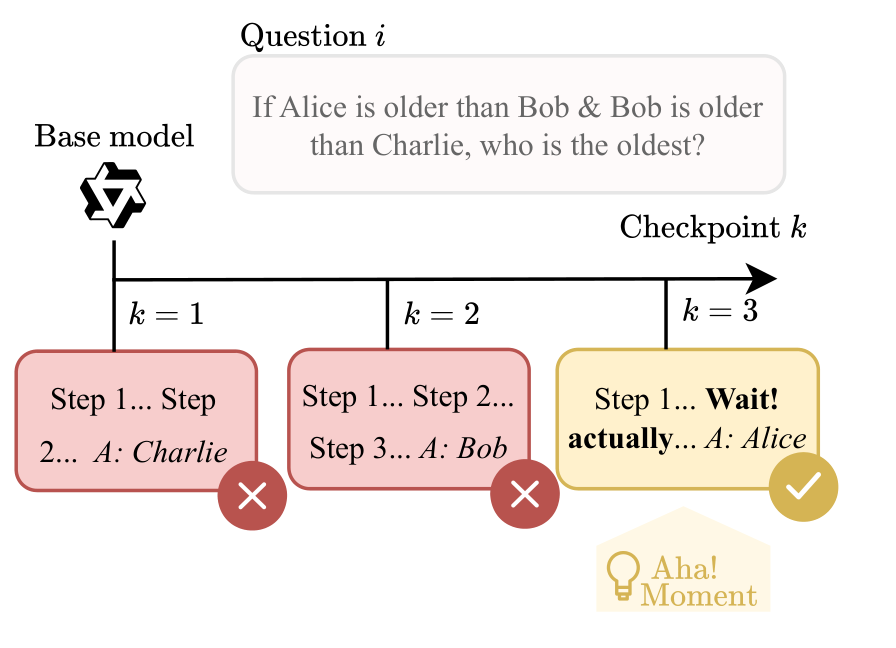
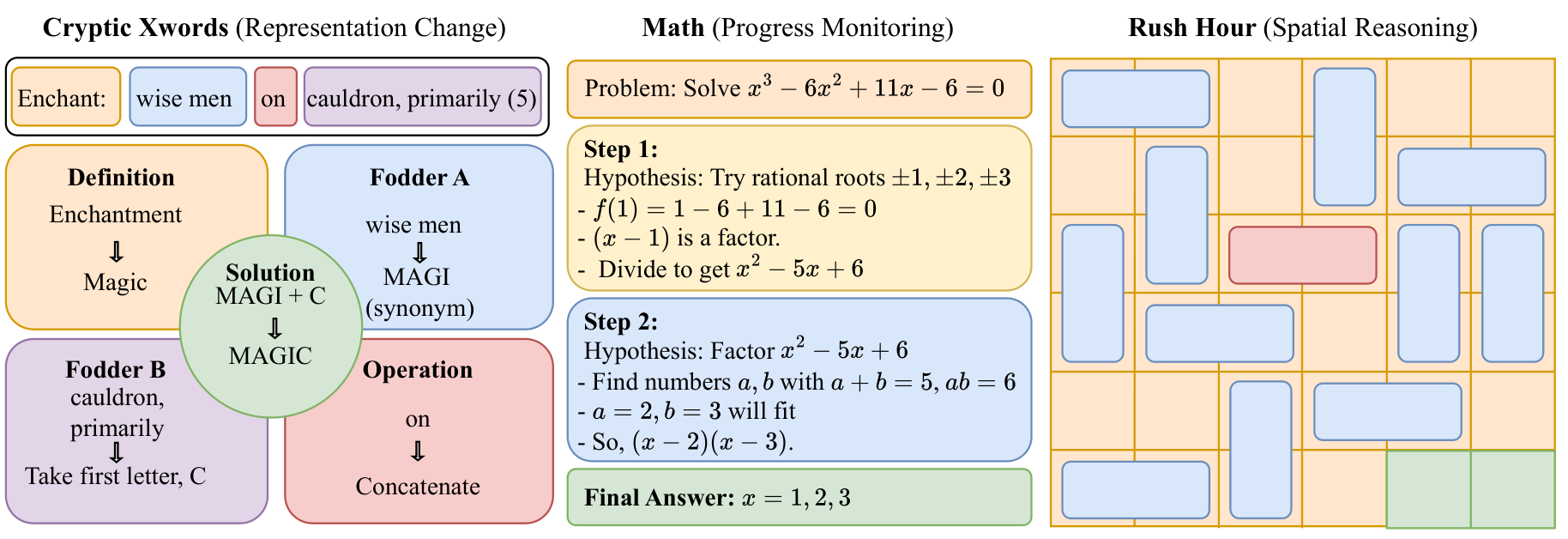
These quantities describe the study’s coverage. They are not independent evidence that a shift helps: that requires measuring correctness and testing interventions. The data and methods sections explain the task construction, model coverage, and annotation process.
What would count as an “aha” moment?
The paper’s operational definition asks for more than a mid-trace expression of doubt. It connects a shift to a previously unsolved problem, prior stability, and an improvement in empirical correctness across the relevant checkpoint evaluations.
This is a measurable definition for the study; it is not a test for subjective experience.
The annotation pipeline combines candidate detection with checks for a material revision, and the paper reports validation and sensitivity analyses.
A phrase such as “let’s check” can introduce a real revision, a repeated calculation, or an unhelpful continuation. Counting the phrase alone would conflate these cases. See the formal definition and annotation details.
What did the study find?
Spontaneous shifts were uncommon and generally did not improve accuracy. Their occurrence did not develop into a reliably beneficial self-correction mechanism as reinforcement learning progressed. The relationship between shifts and correctness also depended on decoding temperature and uncertainty, so a single vivid trace is a poor substitute for systematic evaluation.
A separate, deliberately triggered intervention could help. When the model’s token-level entropy was high, prompting reconsideration improved accuracy in the evaluated settings.
This supports investigating uncertainty-aware interventions. It does not make naturally occurring shifts equivalent to useful self-correction.
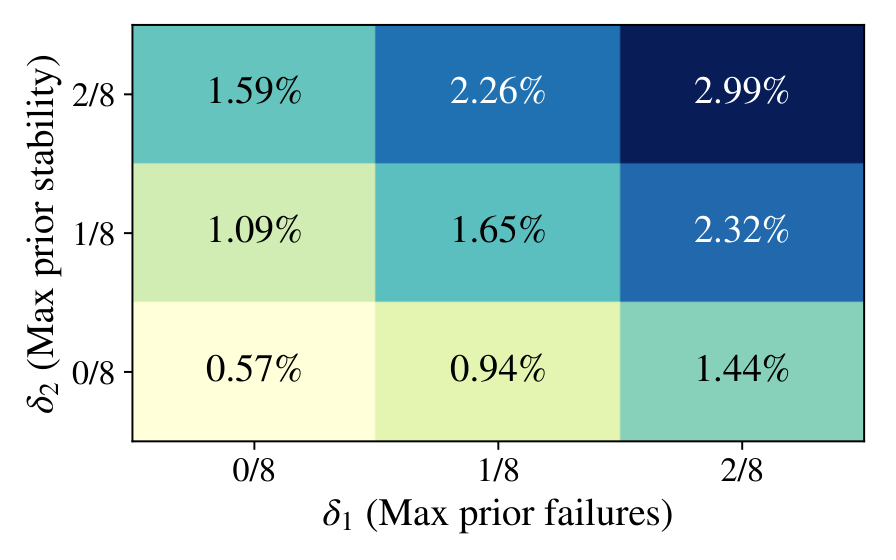
The main results section separates these analyses. The reported interventions should be read together with their task, model, temperature, and triggering conditions.
Why does entropy enter the picture?
Token entropy summarizes how spread out a model’s next-token probabilities are. It gives an observable signal for uncertainty in the generation process. A model with a concentrated next-token distribution and one with a diffuse distribution may respond differently to an instruction to reconsider.
In this work, entropy is a signal used to study and select interventions.
It is not a universal confidence score, a proof that a model is wrong, or a direct measurement of human-like doubt. The uncertainty and intervention protocol specifies how the paper uses it.
How can researchers use this result?
When evaluating a reasoning method, separate the language of self-correction from its measured benefit. Record the final answer, actual revisions, generation conditions, and the rule that triggers any external intervention. Compare against an appropriate baseline instead of selecting only compelling examples.
This paper is useful for designing evaluations of reasoning traces, testing uncertainty-aware inference, and interpreting claims about emergent “aha” behavior during reinforcement learning. The code repository contains the training, inference, and analysis implementation; the publication record below provides the current citation.
Scope and limitations
The evidence concerns the evaluated models and three domains, the study’s operational definitions, and its annotation and uncertainty protocols. Reasoning traces are observable outputs; they do not provide direct access to every internal computation. Rare events and alternative definitions can also affect what an analysis detects.
The findings challenge a particular interpretation of mid-trace shifts. They do not establish that all self-correction methods fail or that reasoning models cannot improve their answers. Read the paper’s limitations before transferring a result to another model or task.
Paper abstract
Do reasoning models have “Aha!” moments? Prior work suggests that models like DeepSeek-R1-Zero undergo sudden mid-trace realizations that lead to accurate outputs, implying an intrinsic capacity for self-correction. Yet, it remains unclear whether such intrinsic shifts in reasoning strategy actually improve performance. Here, we study mid-reasoning shifts and instrument training runs to detect them. Our analysis spans 1 M+ reasoning traces, hundreds of training checkpoints, three reasoning domains, and multiple decoding temperatures and model architectures. We find that reasoning shifts are rare, do not become more frequent with training, and seldom improve accuracy, indicating that they do not correspond to prior perceptions of model insight. However, their effect varies with model uncertainty. Building on this finding, we show that artificially triggering extrinsic shifts under high entropy reliably improves accuracy. Our results show that mid-reasoning shifts are symptoms of unstable inference behavior rather than an intrinsic mechanism for self-correction.
Cite this work
Please cite the research paper. This page is an accompanying explanation.
Show BibTeX citation
@inproceedings{illusionofinsight2026,
  title = {The Illusion of Insight in Reasoning Models},
  author = {Liv G. d'Aliberti and Manoel Horta Ribeiro},
  booktitle = {Findings of the Association for Computational Linguistics: ACL 2026},
  year = {2026},
  url = {https://aclanthology.org/2026.findings-acl.47/},
  doi = {10.18653/v1/2026.findings-acl.47}
}Explanation updated . Publication details and experimental scope are stated above.